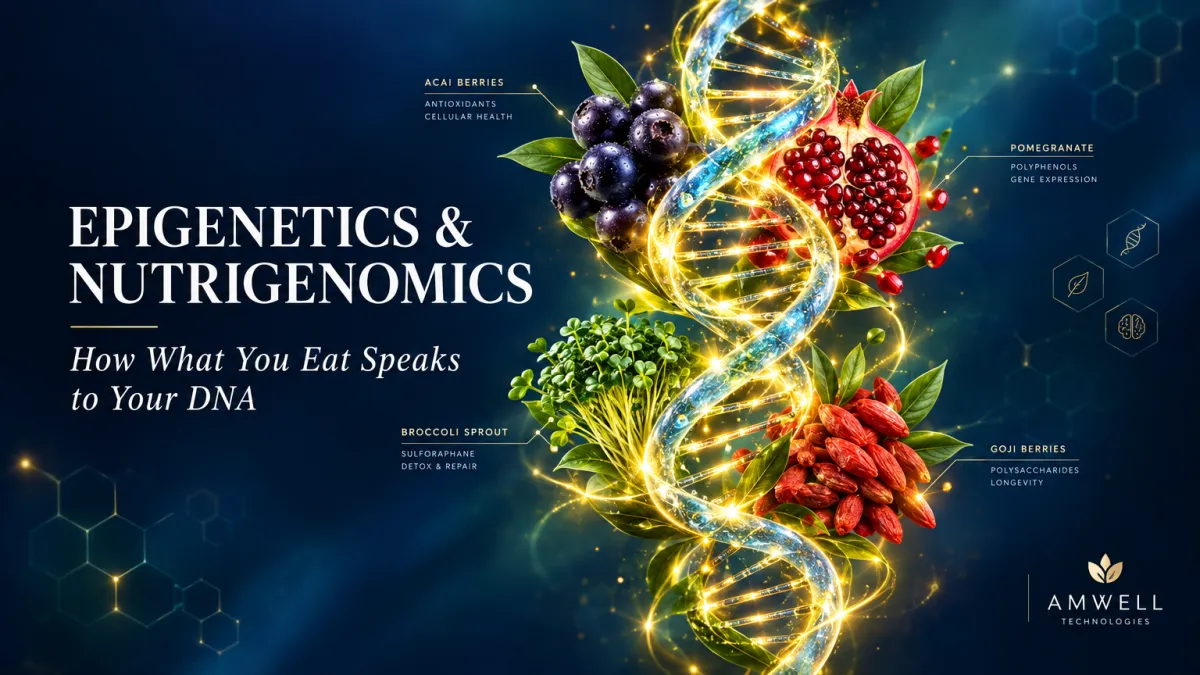
Epigenetics & Nutrigenomics: How What You Eat Speaks to Your DNA
Your Genes Are Not Your Destiny
For most of the 20th century, science held one idea as near-sacred: your DNA is your blueprint. The chromosomes passed from parent to child were believed to form a fixed, unalterable design for your development, your health, and your future.
That idea is now being profoundly rewritten.
Today, a rapidly expanding field of science tells us something both humbling and deeply empowering: the genes you were born with are only part of the story. The lifestyle you live, the food you eat, the stress you carry, and the environment you inhabit all play a dynamic and continuous role in determining how those genes actually behave — and therefore, how healthy and vital you feel throughout your life.
Two sciences sit at the center of this revolution: Epigenetics and Nutrigenomics. Together, they represent one of the most exciting frontiers in wellness and preventive health education today.
What Is Epigenetics?
Epigenetics is the study of heritable changes in gene expression that occur without altering the underlying DNA sequence itself. Think of your DNA as the hardware of a computer — fixed and structural. Epigenetics is the software: the set of instructions that tells the hardware what to do, when to do it, and how loudly.
The word itself comes from the Greek epi, meaning "above" or "over." Epigenetics is, quite literally, the science of what sits on top of your genes.
The Epigenome: Your Gene Volume Control
Every cell in your body contains the same DNA — approximately 3 billion base pairs of genetic code. And yet a liver cell behaves entirely differently from a neuron, which behaves differently from a skin cell. That extraordinary specificity is orchestrated by the epigenome — a vast array of molecular mechanisms that determine which genes are active and which remain silent in any given cell.
Two of the most studied epigenetic controls are:
1. DNA Methylation
Methylation involves tiny carbon-hydrogen molecular groups — called methyl groups — that attach to specific points on a gene. This process acts like an on/off switch: when a gene is methylated, it is typically silenced; when unmethylated, it is available for expression. Methylation is how your body knows that one cell should become a liver cell and another should become a neuron. It is the biological instruction set for cellular identity.
Critically, a disrupted diet can interfere with normal methylation patterns. When methylation goes awry — through poor nutrition, toxin exposure, or chronic stress — cells can receive faulty instructions. Over time, this cellular miscommunication may increase vulnerability to imbalance and disease.
2. Histone Modification
Surrounding your DNA is a protein scaffold called histones. DNA wraps tightly around these proteins, and the degree of tightness controls how "readable" the genetic information is. Think of histones as a volume knob: a tightly wound section of DNA is harder for the cell's machinery to read, while a loosely wound section is more accessible. Various chemical tags on histones — acetylation, methylation, phosphorylation — continuously adjust this knob in response to signals from the body and the environment.
Together, methylation and histone modification form two of the most powerful epigenetic control systems your body uses every day.
Epigenetics, Lifestyle, and Inheritance
One of the most profound — and somewhat sobering — discoveries in modern epigenetics is that some of these epigenetic changes can be inherited. For generations, science assumed that when a sperm and egg combined, the embryo started with a completely clean slate. New research has revised that assumption.
Studies now suggest that approximately one to two percent of epigenetic tags persist across generations. This means that lifestyle patterns — including dietary choices, smoking, chronic stress, and exposure to environmental toxins — may leave epigenetic marks that are passed on not just within a lifetime, but potentially to children and grandchildren.
This discovery has opened entirely new avenues of inquiry into the origins of conditions ranging from metabolic disorders to immune dysfunction, and it has fundamentally shifted how scientists understand the relationship between our choices and our hereditary legacy.
It also places profound responsibility — and profound opportunity — in our hands. Because if lifestyle and environment can negatively alter epigenetic expression, they can also support and restore it.
What Is Nutrigenomics?
If epigenetics is the study of what controls gene expression, nutrigenomics is the branch of science that specifically examines how food and dietary compounds interact with the genome to influence that expression.
The name comes from combining nutrition and genomics. Put simply: nutrigenomics explores the molecular conversation between what you eat and how your genes respond.
This field recognizes that the human diet is far more than a delivery system for calories and macronutrients. Food is biological language — a continuous stream of molecular signals that your cells receive, interpret, and respond to at the genetic level. The quality, composition, and energetic integrity of that food determines the quality of the message it sends.
The Mediterranean Diet vs. the Western Diet: Two Very Different Conversations
Consider two dietary patterns that researchers have studied extensively:
A Mediterranean-style diet — rich in fresh vegetables, legumes, whole grains, omega-3 fatty acids, polyphenols, and antioxidant-dense foods — communicates a message of nourishment, cellular protection, and longevity support to the genome.
A high-sugar, high-trans-fat Western diet — dominated by processed foods, refined carbohydrates, and inflammatory fats — sends a starkly different molecular signal: one associated with oxidative stress, inflammatory gene activation, and accelerated cellular aging.
Research across multiple studies has identified specific compounds in foods that interact with epigenetic pathways in measurable ways. Sulforaphane, found in broccoli sprouts, has been studied for its potential to influence NRF2 — a master regulatory pathway that activates the body's own internal antioxidant defense systems. Polyphenols found in berries, pomegranate, and other richly colored superfruits have been studied for their role in supporting healthy gene expression related to inflammation regulation and cellular repair.
Nutrigenomics tells us: what you feed your cells is what your cells become. The phrase "you are what you eat" has never been more scientifically grounded.
The Power of Color: Phytonutrients and Genetic Support
Scientists have found that consuming a diverse range of fruits and vegetables — particularly across multiple color spectrums — provides a broad portfolio of phytonutrients, each with unique molecular activity. These include:
Carotenoids (orange and red pigments) supporting cellular protection and immune signaling
Anthocyanins (deep purples and blues, such as acai and blueberry) associated with anti-inflammatory gene pathways
Sulforaphane precursors (found in green brassica vegetables like broccoli sprouts) supporting detoxification gene activation
Ellagic acid (found in pomegranate) studied for its potential influence on cell cycle regulation
Vitamin C-dense compounds (found in Camu Camu) supporting collagen synthesis and antioxidant enzyme gene activity
The emerging science is clear: color diversity on your plate correlates with molecular diversity in the signals reaching your genome. The broader your nutritional spectrum, the broader the range of epigenetic support your body receives.
AMGenex DNA Switch ON: Epigenetic Nutrition, Energized
Understanding the science of epigenetics and nutrigenomics raises an important practical question: how do most people actually achieve this standard of nutritional quality in daily life?
Studies consistently show that the vast majority of adults do not consume adequate daily quantities of fruits and vegetables to meet the benchmarks associated with meaningful phytonutrient intake. The standard recommendation for adults is a minimum of 900 to 1,000 grams of fresh produce daily — a target that modern diets, schedules, and food access make difficult to reach consistently.
This is precisely the challenge that AMGenex DNA Switch ON was developed to address.
DNA Switch ON is not a conventional supplement. It is a functional superfood nutrition system built on the dual foundations of nutrigenomic science and AMized Fusion Technology (AFT) — Amwell's proprietary Quantum Resonance Technology.
What's Inside DNA Switch ON
Each sachet of DNA Switch ON concentrates the cellular nutrition of over 14 premium antioxidant-rich superfruits and vegetables, including:
Acai Berries — anthocyanin-rich, associated with cellular protection
Goji Berries — polysaccharide-dense, studied for immune and energy support
Camu Camu — one of nature's highest natural sources of Vitamin C
Broccoli Sprout — a key source of sulforaphane precursors supporting NRF2 activation
Apple Stem Cells — studied for support of stem cell production and skin cellular vitality
Pomegranate — rich in ellagitannins and antioxidant polyphenols
Beetroot, Mango, Amalaki, Noni, Mangosteen, Wild Rosella, Luo Han Guo, Tasmanian Mountain Pepper — each contributing a unique phytonutrient profile
One sachet delivers the antioxidant equivalent of approximately 7 bowls of fresh fruits and vegetables — concentrated, freeze-dried using a Cell Active process that removes water content while preserving the bioactive integrity of each ingredient.
The AFT Difference: Energized, Not Ordinary
What distinguishes DNA Switch ON from conventional superfood blends is the additional layer of AMized Fusion Technology (AFT) — Amwell Technologies Group's proprietary quantum resonance energization process.
Each batch of DNA Switch ON ingredients undergoes a 21-day specialized vacuum chamber process during which negative energetic contaminants are removed and a unique spectrum of quantum resonances — tailored specifically to the product's cellular wellness purpose — is embedded into the nutritional matrix. This process is designed to increase the energetic resonance and bioavailability of the bio-active compounds, supporting more effective delivery of nutrition at the cellular level.
The result is a product that works on two levels simultaneously:
The biochemical level — delivering premium phytonutrients, antioxidants, and epigenetic-support compounds directly to your cells
The energetic level — through AFT quantum resonance, designed to support your body's biofield coherence and innate cellular intelligence
This dual-support approach — nutrition plus energetics — is central to the AMGenex philosophy and reflects the understanding that optimal wellness is not purely chemical. It is also energetic.
How to Use DNA Switch ON
Daily Maintenance:
Mix 1 sachet into 150ml / approximately 4 ounces of water and stir. Consume immediately or within 20 minutes of mixing (sulforaphane compounds are most potent when freshly hydrated). DNA Switch ON can also be blended into smoothies, fresh juice, yogurt, or sprinkled over salads and soups.
Wellness Support During Stress or Illness:
Increase to 2 sachets daily for additional nutritional support during high-stress, high-demand, or active recovery periods.
As a Nutritious Meal Complement:
2 sachets blended with yogurt and fresh mango
2 sachets blended with natural protein powder as a balanced meal complement
DNA Switch ON is suitable for adults and children of all ages.
Your Genes Are Listening — What Are You Feeding Them?
The sciences of epigenetics and nutrigenomics have given us something extraordinary: evidence that our daily choices actively shape our biology. The food we eat is not passive fuel. It is a living conversation with our genetic expression — a conversation that we have the power to influence, every single day.
You were not handed a fixed fate at birth. You were handed a genome that is exquisitely responsive to the environment you create for it — through what you eat, how you move, how you manage stress, and how you nourish yourself at the cellular level.
This is not just science. It is empowerment.
A Gentle Invitation
If this article has sparked your curiosity about the role of nutrition in supporting your genetic wellness, we encourage you to continue exploring. Consider speaking with a qualified nutritionist, integrative health practitioner, or wellness professional about the dietary patterns that may best support your individual needs.
And if you are looking for a convenient, science-informed, energized nutritional foundation to support your daily wellness practice, explore AMGenex DNA Switch ON — a superfood nutrition system designed for those who believe that what they eat should work as hard as they do.
This content is for educational and awareness purposes only. It does not constitute medical advice, diagnosis, or treatment. Please consult a qualified healthcare professional for personal health guidance.
